The Waiting List Before the Shopping List
A waiting list before the shopping list helps you tell a passing urge from a real household need, so you can choose what to buy with more care.
A waiting list before the shopping list can keep a household need from turning into an automatic purchase. When the can opener sticks or a coat hook comes loose, the first urge is often to replace it; a brief pause gives you room to check whether the problem is persistent, solvable, or already covered by something at home.
This is not a test of willpower or a rule against buying useful things. It is a small household ritual for making purchases answer to actual use. Think of the list as a door mat: it gives an idea a place to land before it walks into your home.
What belongs on a waiting list before the shopping list?
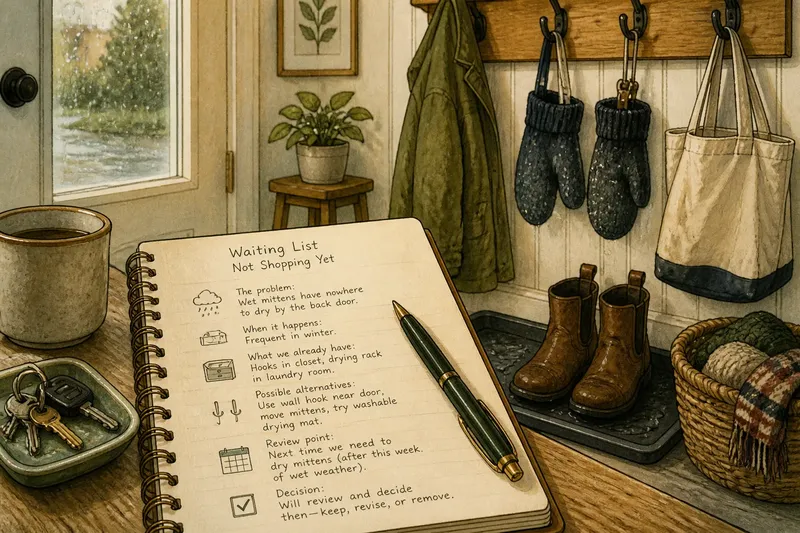
Put an item on the waiting list when you notice a recurring inconvenience but cannot yet say clearly what would solve it. Write down the problem in plain language, the date you noticed it, and the situation in which it occurred. Record “wet mittens have nowhere to dry by the back door,” not “buy a boot tray.”
That distinction matters because a named product can make one solution seem inevitable. The real need might be a hook, a washable cloth, a different spot for the mittens, or no new object at all. Keep the note visible—in a paper notebook near the household calendar, for instance—so the idea does not have to be held in memory.
Include only items you are considering buying for the home or daily life. A routine grocery item you already replace as it runs out does not need the same pause as a second food processor, a decorative basket, or a new organizer for a drawer that has not been sorted.
How long should you wait before buying?
Wait long enough to see whether the need repeats in ordinary life, rather than deciding from the feeling of one frustrating moment. The right interval depends on the item: a missing umbrella matters at the next rainy walk, while a storage box may seem urgent only during a burst of tidying.
Choose a review point that fits the problem, such as the next time you use the room or complete the task. For a seasonal need, wait until the relevant season or occasion comes around if that is practical. If the item is necessary for basic comfort or safety, do not use the pause as a reason to endure a genuine problem; address it sensibly and seek qualified help where the issue calls for it.
At the review, ask whether the inconvenience returned, whether it disrupted an important activity, and whether you still want the same kind of item. If the need has faded, cross it off. If it remains, move the problem—not automatically the product—to a shopping list and consider what would fit.
What should you write down while you wait?
A useful note is brief enough to keep and specific enough to guide a decision. Add these details:
- The problem: What task or moment is harder than it needs to be?
- When it happens: Is it frequent, occasional, seasonal, or tied to one unusual event?
- What you already have: Could an existing item do the job if moved, repaired, or used differently?
- Possible alternatives: Could a small change to a routine or the room solve the problem?
- Your review point: What ordinary occasion will tell you whether the need persisted?
- Your decision: Keep, revise, or remove the item idea after reviewing the note.
For example, say a household keeps buying notebooks because family messages get lost. The note names the problem and records that it happens during weekday mornings; at the review, the household tries a shared pad beside the keys before shopping. If the pad makes messages easy to find, the extra notebooks are no longer the answer; if the problem remains, the note can be revised around what is still missing.
How can you tell a real need from a passing urge?
A real need tends to return in the same concrete situation, while a passing urge often loses its pull once the immediate trigger passes. A promotional display, a beautifully arranged room online, or an untidy closet can make an object feel necessary without showing that it solves a problem in your own home.
Ask what you would do differently if you owned the item. If the answer is vague—“the room would feel more finished”—look for the particular task, comfort, or access problem underneath. If the answer is specific—“I could reach the gloves without moving the bags”—check whether that benefit matters often enough to justify adding another object.
Also distinguish replacement from duplication. If something you depend on has stopped working, the need may be clear even if the replacement choice still deserves thought. If the original works and the proposed purchase would merely add a second version, the waiting period can reveal whether that extra capacity is genuinely useful or simply appealing in the moment.
What if the item still seems necessary?
If the same problem persists after the review, make the purchase decision more precise. Compare the task the item must perform with its size, material, storage demands, care needs, and compatibility with what you already own. A compact metal hook may suit a narrow entry better than a freestanding rack; a washable cotton cloth may be easier to maintain than a delicate decorative piece.
Check the product label and manufacturer instructions for care, fit, and use, and check local rules where they apply. If you are comparing options, keep the problem in view rather than treating extra features as automatic benefits. The best fit is the one that addresses the recurring need without creating a new burden that your household does not want.
Then add the item to the shopping list with a short note about its purpose. That note helps you recognize the right kind of solution when you see it and makes it easier to leave an unsuitable substitute on the shelf.
What questions help you decide whether to buy?
Should every household purchase go on the waiting list?
No. Routine supplies that you use and replenish can follow your usual shopping rhythm. The pause is most useful for uncertain needs, duplicates, organizers, upgrades, and objects prompted by a temporary mood or moment.
What if I forget an item before the review?
That can be useful information if the problem has not returned, though forgetting alone does not prove the item was unnecessary. Keep the note where you naturally plan household tasks, and decide from the recorded situation rather than trying to reconstruct the original urge.
Can I use the list for gifts or secondhand finds?
Yes, if the question is whether the item suits your household, not just whether it is available or inexpensive. A gift can still take up space and require care, while a secondhand find can still be an impulse purchase.
What if the waiting period makes the problem worse?
Shorten or skip the pause when delay would make an essential task impractical or leave someone without a basic necessity. The list is a decision aid, not a reason to ignore a pressing household need.
How does a waiting list change the way things enter the home?
A waiting list before the shopping list turns a purchase into a response to a named, recurring problem rather than a reflex to discomfort. It also makes room for non-shopping answers: moving a tool closer to where it is used, repairing a loose part, borrowing an occasional-use item, or changing where a task happens.
Keep the ritual light. Review the notes when you plan errands or tidy a room, remove ideas that no longer fit, and carry forward only the needs that still make sense. The useful result is not an empty shopping list; it is a home where new belongings arrive with a clear job and a place to do it.