A Routine You Can Resume
A cue-based routine can survive an interrupted week. Learn how to choose a reliable prompt, keep the action small, and restart without a perfect schedule.
A cue-based routine can make a habit easier to resume after an interrupted week because it attaches an action to something that still happens, not to a clock time that may disappear. If an unexpected call fills your morning, a habit linked to your first cup of tea can wait for the tea instead of becoming another missed appointment.
Fixed-time routines can work well when your days are predictable. Cue-based routines offer another kind of support: they give an action a recognizable place in ordinary life, even when the hour shifts. Choose the approach that fits your day rather than forcing every habit into the same shape.
How do you choose a cue-based routine over a clock time?
A fixed-time routine says, “I stretch at seven.” A cue-based routine says, “I stretch after I put the kettle on.” The first depends on being free at a particular moment; the second depends on an event that can happen at different times.
Look for something that already anchors the relevant part of your day. It might be locking the front door, setting down your work bag, feeding a pet, or closing your laptop. A useful cue is noticeable and likely to occur, but it does not need to be impressive.
There is a tradeoff: if the cue is tied to an activity that changes often, such as a variable commute, the routine may be harder to find. If a fixed time genuinely fits your schedule, keep it. A cue is an alternative, not a rule that every habit must follow.
How can you attach one small action to the cue?
State the link plainly: “After I pour my tea, I write one line in my journal.” Keep the action specific enough that you know when it is done. “Take better care of myself” may express a real intention, but it does not tell you what to do when the kettle clicks off.
Choose a version that can fit an ordinary day. If you want to read, open the book and read a page. If you want to tidy, return one item to its place. A small action makes the starting point clear when energy is limited; it does not have to grow into something larger.
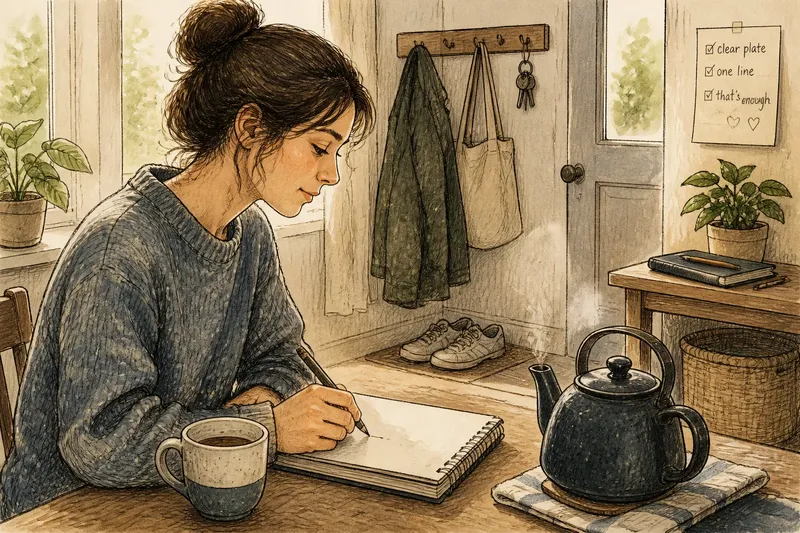
Imagine you want to practice sketching, but your evenings are unpredictable. You choose clearing your dinner plate as the cue and leave a pencil beside your sketchbook. After the plate is cleared, you make one line on the page; the result is a visible mark, and the routine does not depend on dinner ending at a particular hour.
How do you make a cue easy to notice and use?
A cue can be a moment, an object, or a change of place. A yoga mat beside the chair where you change clothes can remind you to stretch after work; a watering can near the plants can prompt a check when you open the curtains. The object is a reminder, not a demand.
Use placement to avoid an unnecessary search. Put the notebook where you make tea, keep walking shoes near the door, or set a reusable bag by the keys if that is where you prepare to leave. Like a bookmark holding your place in a book, a well-placed cue helps you locate the next action.
Keep the setup modest. If arranging a special corner or buying new gear becomes a project of its own, use what you already have. Ask whether the cue will be visible at the moment it matters.
What should happen when a cue is missed?
An interrupted routine needs a return point, not a penalty. Choose a simple fallback: use the next occurrence of the cue, or pick a nearby cue that reliably follows it. If you miss your usual evening moment, putting your phone on its charger might prompt a brief journal entry.
Keep the fallback related to the original habit. A missed walk does not have to be “made up” with a demanding workout; you might instead put on your walking shoes at the next suitable opportunity. The purpose is to make returning clear, not to turn a disrupted day into a debt.
For a household routine, make the cue visible to the people involved. A note beside the recycling bin may help everyone remember to check it when taking out the trash. Agree on the action together instead of relying on one person to quietly carry the reminder.
How do you adapt a cue-based routine when your week changes?
Some routines lose their prompt because the surrounding pattern shifts. A new work schedule may remove the quiet moment after breakfast; a seasonal change may alter when you leave home. If the cue no longer occurs, repeating the same instruction will not make it more reliable.
Look for a replacement event that already belongs to the new pattern. If breakfast has become rushed, putting your lunch container in the sink might cue a short stretch when you get home. Change either the cue or the action first, so you can tell what still fits.
For choices that depend on a product label, manufacturer instructions, or local rules, follow those directions rather than adapting them to a habit cue.
Which cue-based routine questions matter most?
Is a fixed-time routine better than a cue-based routine?
Neither is automatically better. A fixed time can suit a stable schedule, while a cue can suit a day whose timing shifts; choose the one you are more likely to encounter without rearranging your life around it.
What makes a good cue for a habit?
A good cue is noticeable, specific, and connected to a moment you already experience. “After I lock the door” is easier to recognize than “sometime before lunch.”
Can I use more than one cue?
You can use a backup cue if the first one often disappears, but keep the action clear. For instance, “after breakfast, or after I put my work bag down if breakfast is rushed” gives you two recognizable entry points.
What should I do after missing a routine?
Return at the next cue that fits, without trying to compensate for every missed occasion. If the cue itself has stopped appearing, choose a new one that belongs to your current week.
How can you tell whether a routine still belongs in your day?
A routine can be easy to resume and still no longer be useful. Check whether the action supports the reason you chose it, whether its cue remains natural, and whether the smallest version is still worth doing. If not, revise it or let it go.
The most useful cue-based routine is not the one that survives every disruption unchanged. It is the one whose prompt and action remain simple enough to recognize, adapt, and resume. Start with one existing moment in your day and give it one clear action to carry.