The Story Behind a Keepsake
The story behind a keepsake grows through use and memory. Record its people, moments, and changing meaning so its history stays close to the object.
A keepsake’s story often begins with an ordinary act: a key carried through years of moves, a chipped mug saved after a favorite relative’s kitchen was cleared, a ticket tucked into a book. The story behind a keepsake is not always obvious from the object itself. A short, thoughtful record can keep the people, moments, and everyday use that gave it meaning close at hand.
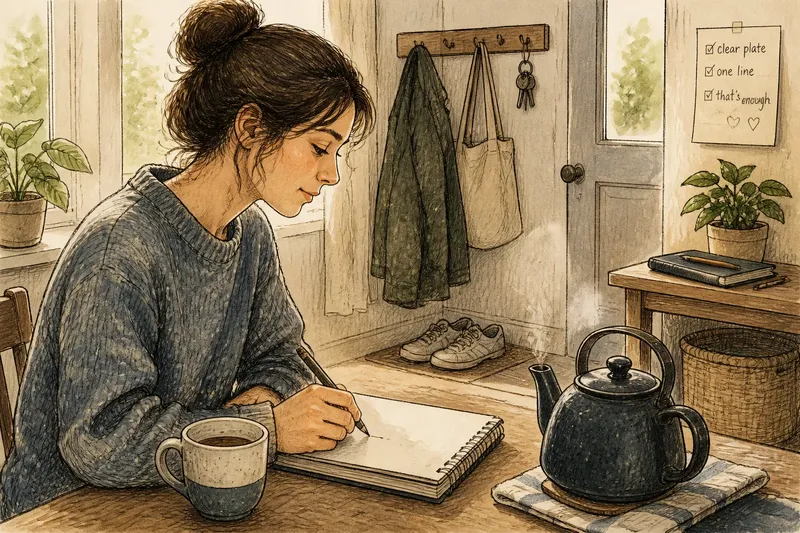
Rather than trying to produce a polished family history, spend a week noticing what the object brings to mind and writing down what you can actually recall. The result can be a note in a drawer, a card tied to the item, or a digital record linked to a photograph. Think of it as a luggage tag for memory: small enough to stay with the object, useful enough to help someone recognize where it belongs in your life.
Which object carries a story you want to keep?
Choose one object that already has a place in your home. It might be a worn recipe card, a shell from a particular walk, a child’s drawing, or a tool used by someone you miss. Pick something you can handle safely and comfortably; the object does not need to be rare, valuable, or attractive to anyone else.
Notice what makes this item different from a similar one. Is there a repaired seam, a handwritten mark, a particular smell, or a way it fits your hand? These details can prompt a memory, but they are not the whole story. The relationship between the object and your life is the part worth recording.
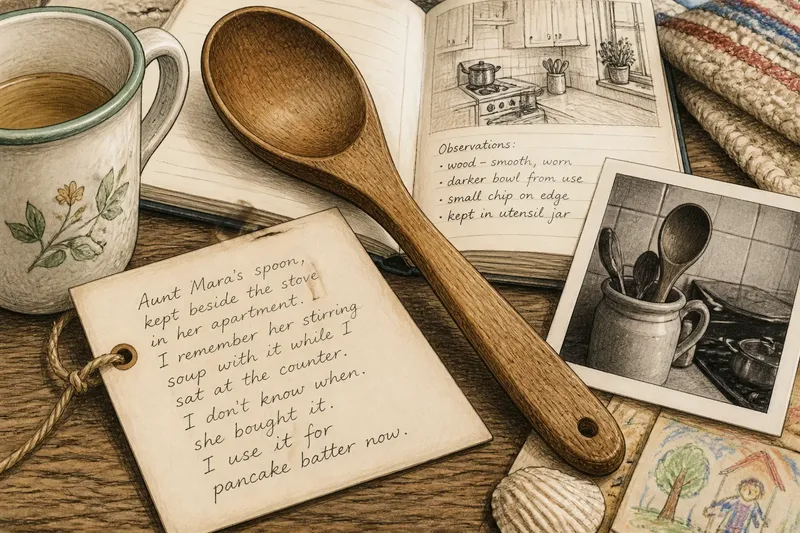
Say you have a wooden spoon that belonged to your aunt. You remember seeing it beside the stove, but you are not sure when she bought it. You can record the kitchen scenes you do remember, note that the purchase date is unknown, and leave that gap open rather than filling it with a guess.
What can you notice before writing?
Set aside a few quiet minutes and look at the object as it is, not as an heirloom you think it ought to be. Write a handful of plain observations: its material, color, marks, repairs, and where it is usually kept. Distinguish what you can see from what you remember. “Blue thread at the cuff” is an observation; “Grandpa repaired this” is a memory that may need a source or a note of uncertainty.
Then consider use. Was the object handled daily, brought out for a particular occasion, or kept untouched in a box? Did its job change over time? A serving dish might have held holiday food, then become a catchall for keys. That shift is not a distraction from its story; it shows how the object remained part of everyday life.
How can you record the story behind a keepsake?
Use a small card, a notebook, or a digital note. Choose the format you are likely to revisit, and keep the object’s care needs in mind: avoid attaching anything with adhesive or ink that could damage a surface. If you photograph it, include a close view of distinctive marks as well as a familiar view that shows its place in the home.
Write in fragments if full sentences feel stiff. A few precise details are easier to trust and reread than a grand explanation. You can use these prompts as a starting point:
- What is it? Name the object plainly, including its material or a visible feature.
- Who is connected to it? Record names and relationships as you know them.
- Where did it come from? Separate what you were told from what you infer.
- When do you remember it? Describe a scene, season, room, or recurring use.
- What changed? Note a repair, a new owner, or a shift in purpose.
- What does it mean to you now? Say why you keep it, even if the answer is simple.
For the wooden spoon, a compact note might read: “Aunt Mara’s spoon, kept beside the stove in her apartment. I remember her stirring soup with it while I sat at the counter. I don’t know when she bought it. I use it for pancake batter now.” That is enough to connect a specific object to remembered use without claiming more than the writer knows.
What questions can help when a detail is unclear?
How do you record a memory you are unsure about?
Mark uncertainty in ordinary language: “I think,” “I remember,” or “I was told.” If the detail matters, note who supplied it and when you heard it, without treating recollection as a verified record.
What if no one remembers where the object came from?
Begin with what is visible and what you know about its place in your home. “Found in the hall cupboard when we moved” is useful context, even if its earlier history is unknown.
Should you include a photograph?
A photograph can show wear, color, or scale that words miss, especially if the object is later stored away. Add a brief caption that identifies the item and the date the photo was taken, if you know it.
How do you record a story without making the object feel untouchable?
Describe how it is used now as well as what came before. A keepsake can carry a memory and still belong in an ordinary routine, rather than being treated as too precious to handle.
What can you do across one week?
Give the task a light structure so it does not turn into an attempt to document everything you own. One week is enough to notice, draft, and place a record; you can stop when the note feels true to what you know.
- Day one: choose. Select one object and say, in a sentence, why it caught your attention.
- Day two: observe. Note visible details, its location, and signs of use or repair.
- Day three: remember. Write down a scene or recurring moment connected to it. Keep separate what you witnessed and what you heard later.
- Day four: ask, if useful. If someone may know more, ask an open question such as, “What do you remember about this?” Record their words as their recollection, not as a fact you independently confirmed.
- Day five: draft. Use the prompts to make a brief note. Leave unknown details blank or label them as unknown.
- Day six: add context. Take a photograph or describe where the item lives and how it is used now.
- Day seven: place and review. Put the note somewhere it can be found with the object, or save it in a clearly named digital folder. Read it once and remove anything that sounds more certain than you feel.
How should the record change as the object’s meaning changes?
A keepsake’s meaning can grow, soften, or become complicated. An object inherited after a loss may first feel like a direct link to someone, then later remind you of a particular habit or conversation. You do not have to settle on one permanent interpretation. Add a dated note when a new memory or use becomes important, leaving the earlier entry intact.
If the object passes to someone else, give them the record as context, not as an instruction about what they must feel. They may use it differently, store it elsewhere, or choose not to keep it. A clear account of what you know offers connection without turning affection into an obligation.
When you write the story behind a keepsake, favor the small details you can picture: a drawer that stuck, flour on a sleeve, the sound of a familiar key in a lock. Those details let a reader meet the object in its lived setting. The most useful record is not the longest one; it is the one that makes the object’s place in your life understandable while leaving room for its next chapter.